 DigiGrowvity
A family asks about Kerala in December, then goes quiet for a week. Another wants a quote for a corporate trip to Dubai, and a third is waiting on the balance payment for a booking already confirmed. ERP for travel agencies keeps these threads from tangling. JULIO ERP brings enquiries, quotations, invoices, a departure calendar and email campaigns together, with no limit on users on your own network.
What ERP for travel agencies needs to do
A travel desk lives on conversations that stretch over days, and money that moves in instalments. ERP for travel agencies should be judged on five jobs.
- Remember every enquiry. Dates, headcount, budget and the last call, so the next person does not start from scratch.
- Send a quotation that can be accepted. The same package may be priced differently for a family of four and a group of twenty.
- Collect in stages. An advance to hold the booking, a balance before travel, and a record of which is which.
- Track what you owe suppliers. Hotels, transport operators and activity providers send bills that need paying on time.
- Stay in touch between trips. A past traveller is the cheapest next booking.
| Need | Module that covers it |
|---|---|
| Enquiries and follow-ups | CRM |
| Quotations and confirmed bookings | Sales |
| Advances, balances, supplier bills | Invoicing |
| Departure dates and client calls | Calendar |
| Seasonal offers and newsletters | Email Marketing |
The common starting set for ERP for travel agencies
This is the usual first set for ERP for travel agencies, and we confirm yours in discovery once we know whether you sell packages, tickets or both. Each module links to its own page.
 CRMTrack leads and close deals
 SalesQuotations, orders and follow-ups
 InvoicingInvoices, bills and payments
 CalendarMeetings and schedules
 Email MarketingCampaigns and newsletters
CRM for the enquiry trail
The pipeline board moves an enquiry through stages such as New, Qualified, Proposition and Won, and each card carries an amount. A travel desk would rename these to something like Enquiry, Itinerary sent, Advance received and Confirmed. See the CRM module.
Sales for quotations and bookings
A quotation lists what is included and what it costs, and becomes an order once the client agrees. Because the quote is a record rather than a message, the version the client accepted can always be found again. The orders list shows the customer, the total and whether it still needs to be invoiced. See the Sales module.
Invoicing for advances, balances and bills
Customer invoices show a due date and an amount due, so an unpaid balance is visible before the departure. The same module holds vendor bills, which is where hotel and transport payables live. See the Invoicing module.
Calendar for departures and calls
A departure date, a visa appointment or a call with a group leader can be a meeting with attendees. See the Calendar module.
Email Marketing for repeat travellers
Mailings show how many were sent and opened, which tells you which season's offer people actually read. See the Email Marketing module.
What ERP for travel agencies looks like on screen
These are real screens from the JULIO ERP demo, whose sample company sells fit-outs and furniture. Names and figures are demo data, and none of it is a travel business.
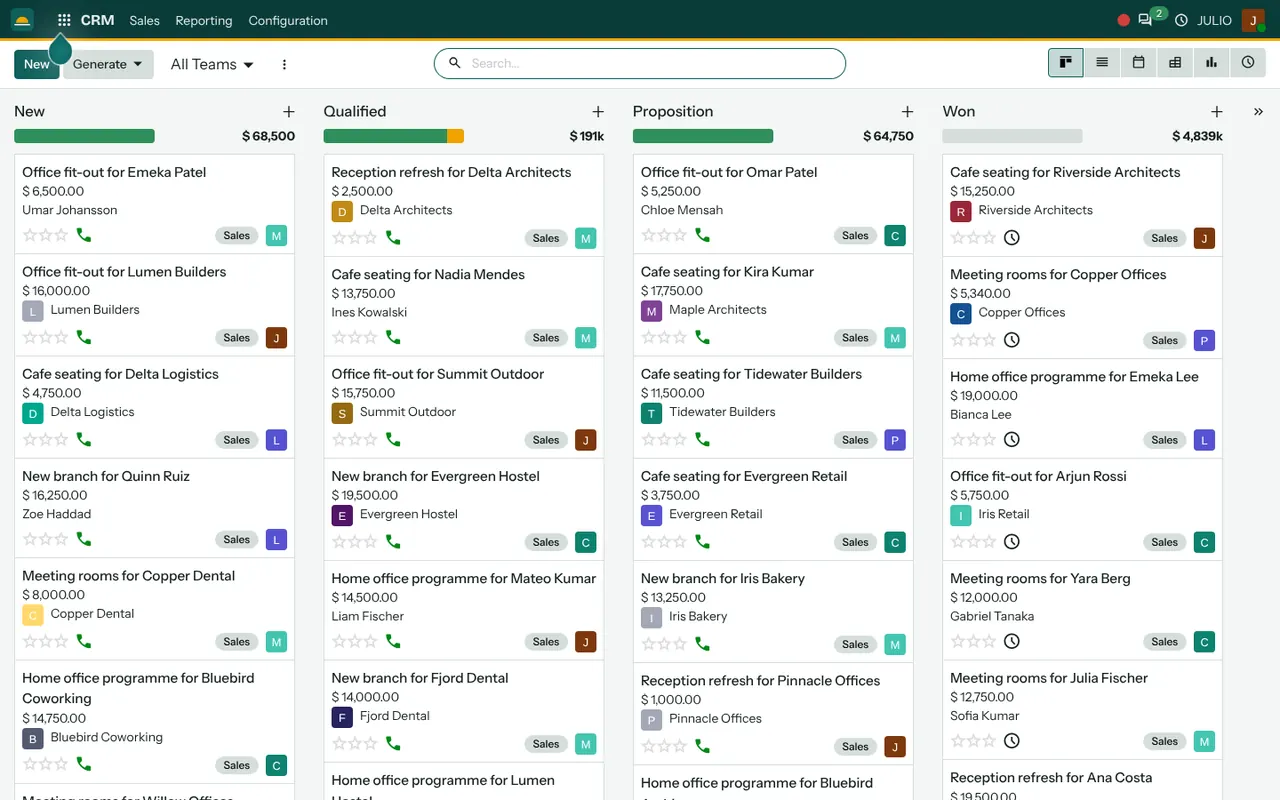
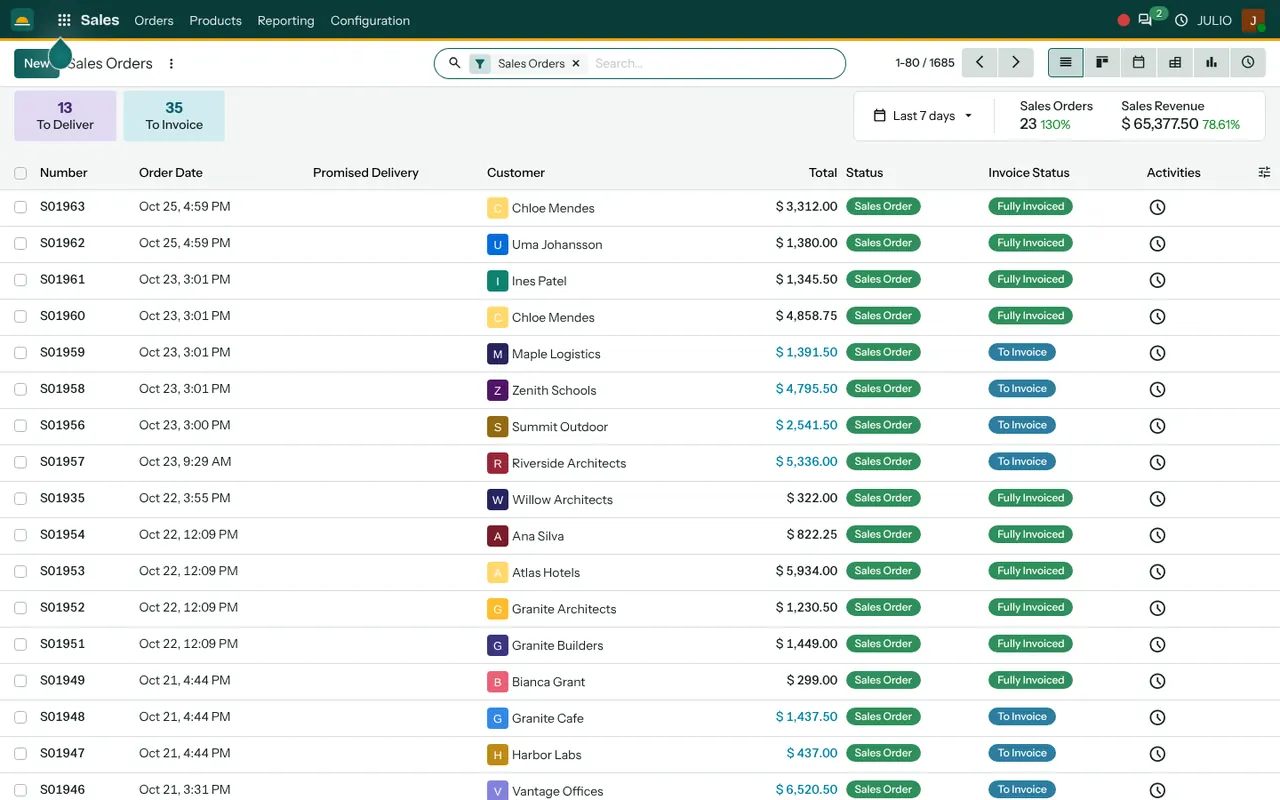
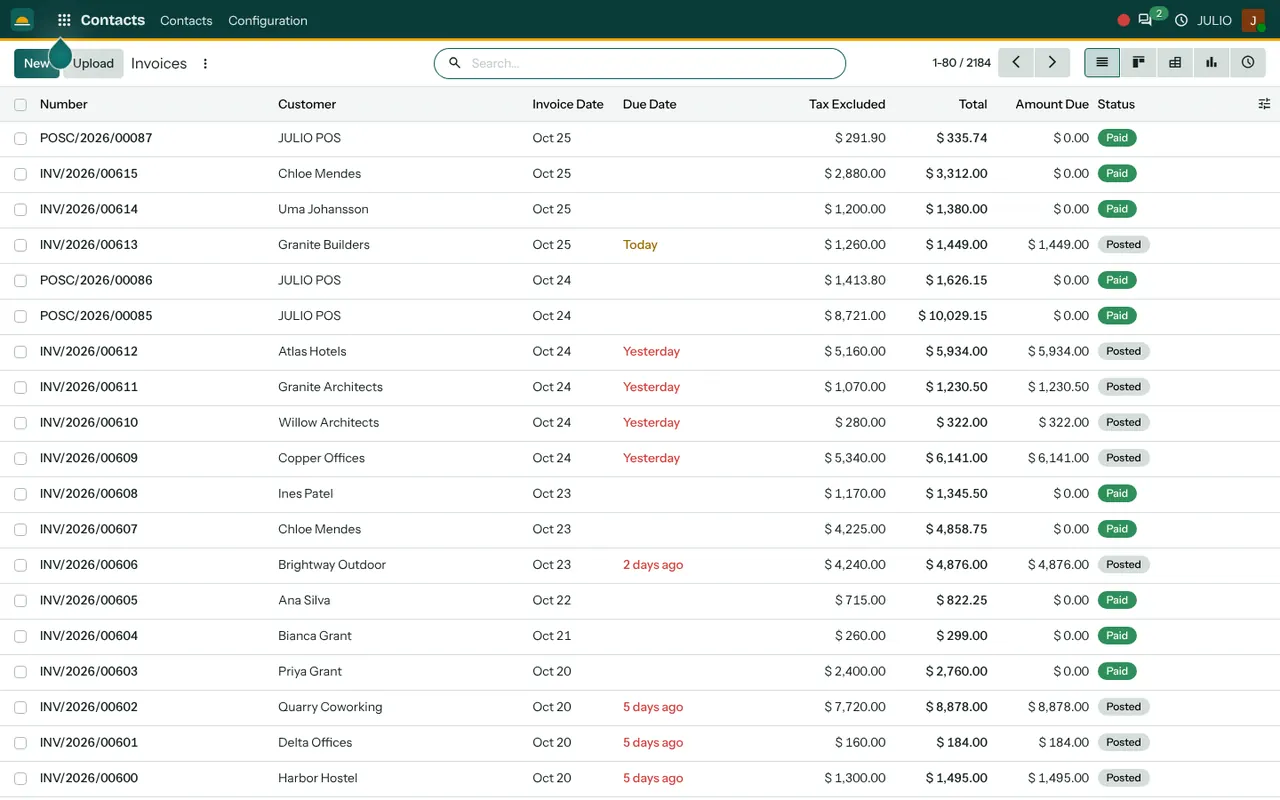
The first screen is a pipeline board with four columns and a money total over each. The second is the sales orders list, with order number, date, customer, total, status and an invoice status that reads To Invoice or Fully Invoiced. The third is the customer invoice list, where a Paid or Posted label sits beside the amount due.
What JULIO does not do for travel agencies
Be clear about the edges before you plan around the software. ERP for travel agencies from JULIO is a back office, not a reservation system.
- It is not a booking engine. It does not search airline fares or hotel availability, and connecting to a travel portal is custom work, quoted separately.
- It does not file your tax returns or work out tax collected at source for you. Your accountant decides how those are treated.
- It does not build day-by-day itineraries as a designed document. A designed itinerary or a branded quotation template is custom work, quoted separately.
- It does not handle visa processing or passenger documents as a managed workflow.
How a first release of ERP for travel agencies could look
For a small agency, a first release of ERP for travel agencies is the enquiry board and the invoice list. Put this month's open enquiries on the board, and issue every new advance receipt from the invoicing screen. That alone ends the evening hunt through WhatsApp for who paid what. Most agencies find that two or three people sharing one list of enquiries is a bigger change than any new feature.
Quotations come next, once the team agrees how a package is described. In the later steps of ERP for travel agencies, calendar entries for departures follow, and email campaigns are saved for the quiet months, when a clean list of past travellers is most useful.
Conclusion
ERP for travel agencies is mostly about memory and money: who asked, what was promised, what has been paid and what is still due. At DigiGrowvity, in our experience setting up ERP projects, the simplest first release is the one that people keep using. For a travel desk, that means starting with the enquiry board and the invoice list, then letting quotations, dates and campaigns arrive when the team is ready.
Key Takeaways
- ERP for travel agencies should track enquiries, quotations, staged payments, supplier bills and past travellers.
- The common starting set for ERP for travel agencies is CRM, Sales, Invoicing, Calendar and Email Marketing.
- Booking engines, fare search and visa workflows are custom work, quoted separately.
- JULIO runs on your own network, with no limit on users.
- The plan is ₹10,000 once, with 1 year of free technical support.