 DigiGrowvity
A jeweller sells trust as much as metal. A necklace is a high-value item, the buyer is often a family you have served for years, and every piece in the showcase is slightly different from the one beside it. ERP for jewellery shops has to respect that. It keeps pieces as individual records, gives the showroom a billing till and a quotation desk, and holds each customer's history in one place. JULIO ERP offers these with no limit on users on your own network.
What ERP for jewellery shops needs to do
A jewellery showroom has few transactions compared with a grocery store, but each one carries far more weight.
| Need | Module that covers it |
|---|---|
| A bill at the showroom counter | Point of Sale |
| Stock held piece by piece | Inventory |
| Quotes for weddings and custom orders | Sales |
| Tax invoices with GST | Invoicing |
| Family and customer records | Contacts |
- Individual pieces, not bulk counts. Two rings of the same design are never quite the same. Stock works better when each piece can be identified.
- A quote before a bill. Wedding sets are often discussed over several visits, so a quotation that can be revised matters.
- Long customer memory. Anniversaries, ring sizes and earlier purchases are the real sales tool of a jeweller.
- Tax that is right. Every high-value bill carries GST, and a mistake is expensive to correct.
- Security of the record. Who changed a bill or a price should not be a mystery.
The common starting set for ERP for jewellery shops
Jewellers usually start ERP for jewellery shops with the five modules below. This is a common first set and not a promise, and we confirm yours in discovery.
 Point of SaleFast checkout for shops and counters
 InventoryStock across every warehouse
 SalesQuotations, orders and follow-ups
 InvoicingInvoices, bills and payments
 ContactsCustomers and suppliers
Point of Sale for the showroom counter
In ERP for jewellery shops the till suits a showroom that wants a quick, tidy bill at the counter. The cashier picks items by category or search and can attach the customer to the sale, which links the bill to the family it belongs to. See the Point of Sale module.
Inventory, to know what is in the showcase
Stock is held by item and location, so the showcase, the strong room and the workshop can be counted apart. Products can be tracked by serial number, which suits one-of-a-kind pieces, and this is a setting we decide with you at the start. See the Inventory module.
Sales for quotations and custom orders
A wedding purchase seldom happens in one visit, and ERP for jewellery shops should expect that. A quotation can be created, revised and then confirmed into an order, and the order list shows what is still to deliver and what is still to invoice. See the Sales module.
Invoicing for tax-correct bills
Invoices carry the taxes configured for your goods, and the list shows paid, posted and overdue bills at a glance. We configure GST taxes and HSN codes in our implementation projects. See the Invoicing module.
Contacts for your regular families
Contacts keeps customers and suppliers in one list with name, email, phone and country, and with a clock icon for scheduled activities. For a jeweller using ERP for jewellery shops, a reminder to call before an anniversary belongs here. See the Contacts module.
What ERP for jewellery shops looks like
These are real screens of ERP for jewellery shops from the JULIO demo database. The demo business is a furniture and fit-out company with a shop, so every item and figure is demo data, not jewellery.
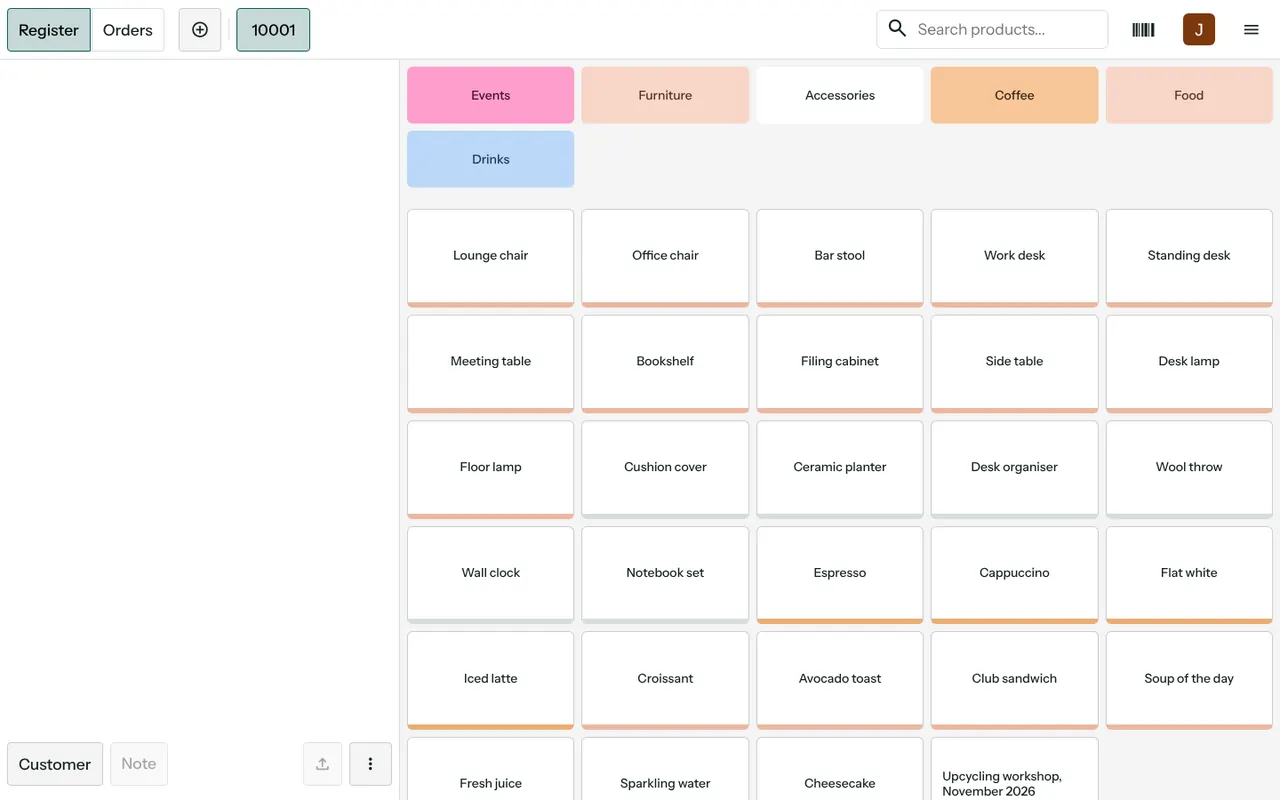
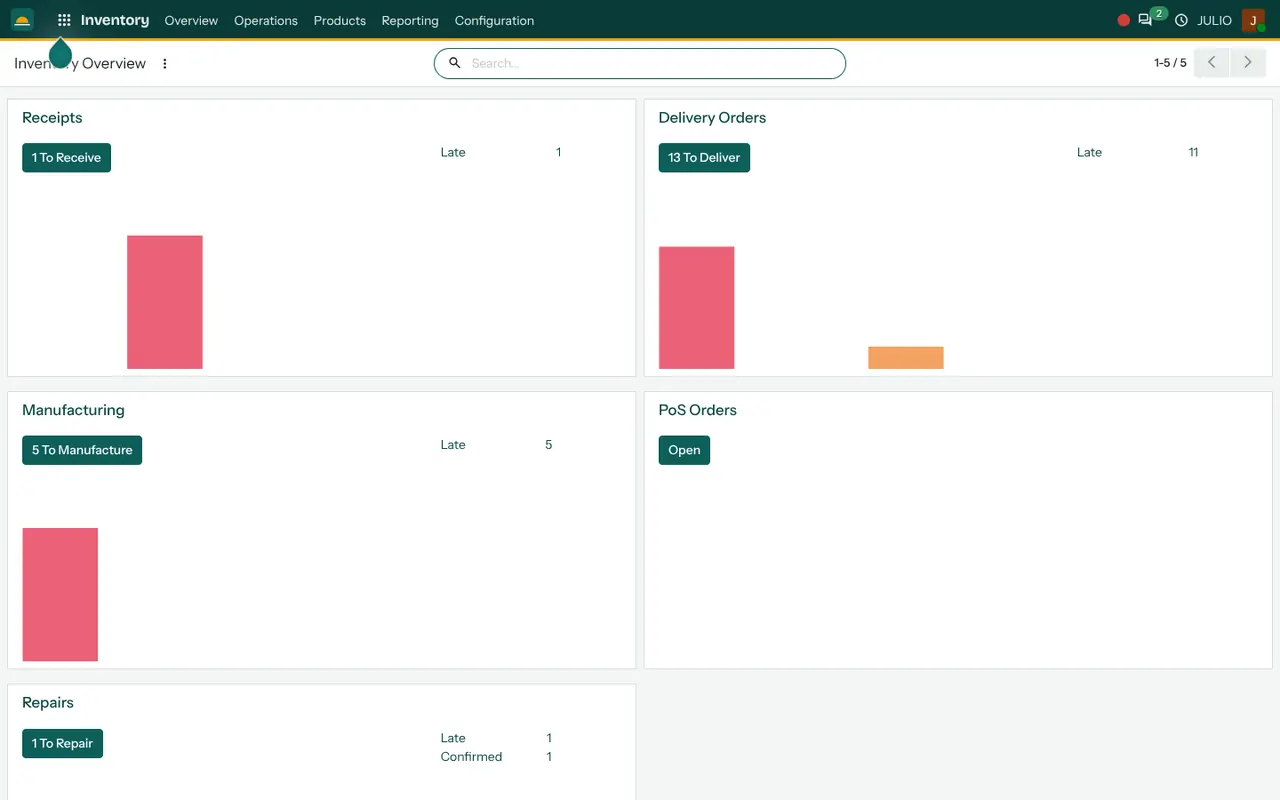
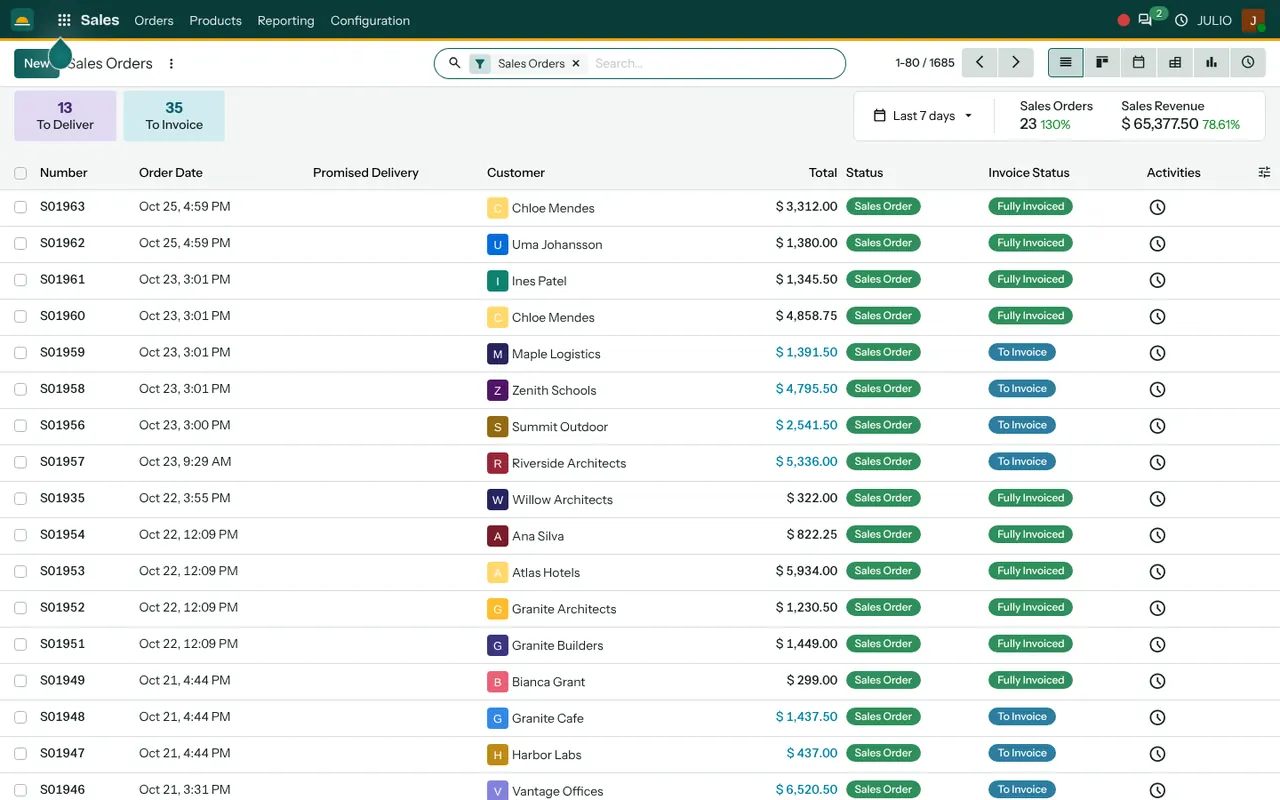
The till shows product tiles under category buttons, with a search box and a barcode icon at the top. The inventory overview shows receipts, deliveries and other work as counts with a late figure. The first sales screen lists orders by number, date, customer and total, with badges for To Invoice and Fully Invoiced.
What JULIO does not do for jewellery shops
This trade has needs that a general business system does not cover, and for ERP for jewellery shops we would rather state them now.
- Daily gold rate and weight-based pricing. Pricing a piece from net weight, purity, wastage and making charges is custom work, quoted separately.
- Old gold exchange and purchase. Taking in old jewellery against a new sale needs its own screens, and we scope it separately.
- Hallmark and HUID records. Hallmarking compliance with BIS stays your responsibility. Storing the identifiers can be discussed, but a dedicated register is custom.
- Karigar and metal ledgers. Issuing metal to craftsmen and reconciling returns by weight is custom.
- Savings schemes. Monthly instalment schemes for customers are not a starting item.
How a first release of ERP for jewellery shops could look
A first release of ERP for jewellery shops is built around the catalogue. Each piece is listed with a code, a category and an agreed selling price, and the first physical count is done with the staff who know the showcase. The till goes live for plain sales, with quotations for wedding orders running alongside. Customer records are cleaned from your existing list. Anything weight-based is treated as a separate, quoted phase so it does not delay the basics.
Conclusion
ERP for jewellery shops should feel as careful as the shop itself. At DigiGrowvity we set up JULIO ERP for growing businesses, and in our experience of setting up ERP projects, the first release goes best when the catalogue is counted by the people who know the pieces. The till, the quotation desk and the customer list can then be added in a calm order, with weight-based pricing scoped honestly as custom work.
Key Takeaways
- ERP for jewellery shops needs pieces tracked individually, a quotation desk and long customer memory.
- The common starting set is Point of Sale, Inventory, Sales, Invoicing and Contacts.
- Products can be tracked by serial number, which is decided in set-up.
- Gold rate pricing, old gold exchange, hallmark registers and karigar ledgers are custom work, quoted separately.
- The plan is ₹10,000 once, with unlimited users and 1 year of free support.