Why Remarketing Is Your Highest-ROI Ad Strategy?
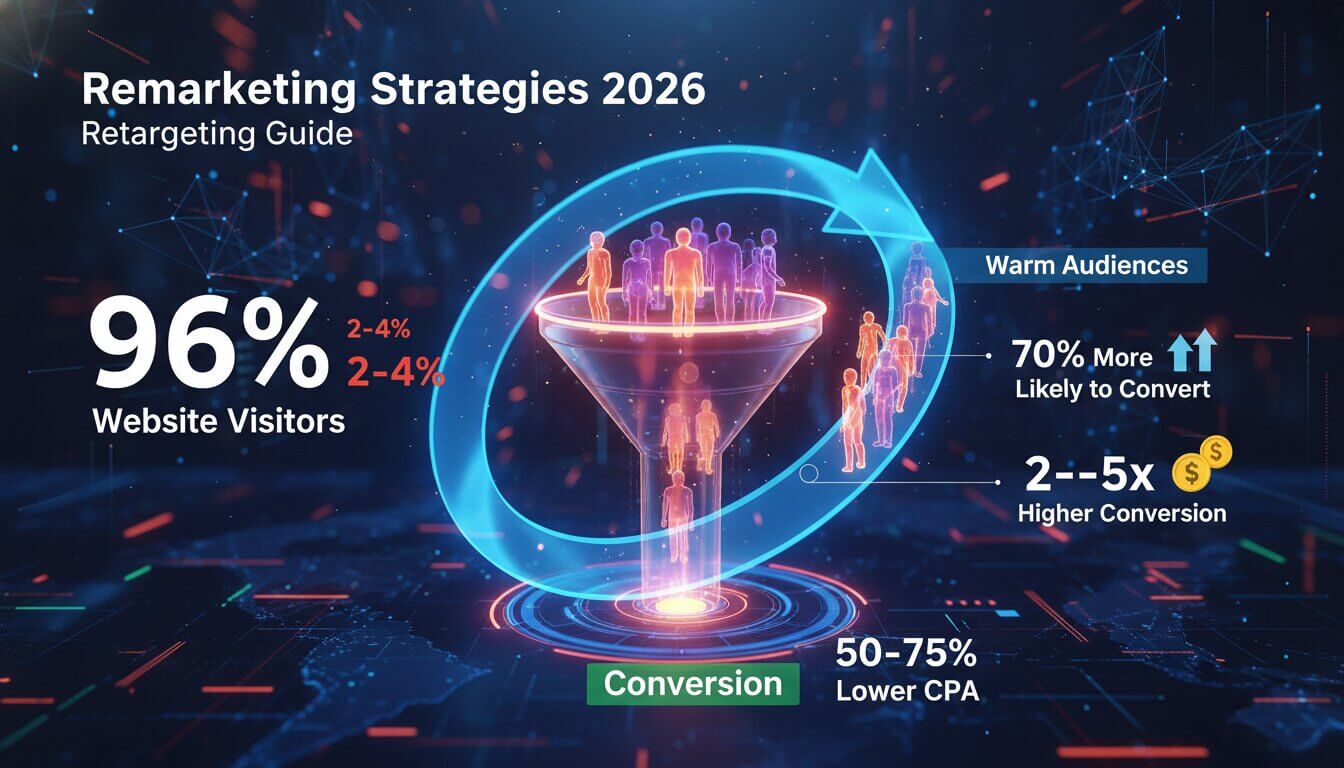
Only 2-4% of website visitors convert on their first visit. Remarketing (also called retargeting) reaches the other 96-98% — people who showed interest in your business but left without converting. These warm audiences are 70% more likely to convert than cold traffic because they already know your brand, have seen your offerings, and demonstrated interest through their visit. Remarketing typically delivers 2-5x higher conversion rates and 50-75% lower cost per acquisition than prospecting campaigns.
How Remarketing Works?
When someone visits your website, a small piece of code (pixel or tag) adds them to a remarketing audience list. You can then show these visitors targeted ads as they browse other websites (Google Display Network), use social media (Facebook, Instagram), watch YouTube videos, or search Google. The ads remind them of your brand, address potential objections, and incentivise them to return and complete their action.
Strategy 1: Segment Your Remarketing Audiences
Not all website visitors are equal. Segment your remarketing audiences based on engagement depth and intent signals for dramatically better results:
- Homepage Visitors: Broad awareness — show brand-building ads highlighting your unique value proposition and social proof.
- Service/Product Page Visitors: : High intent — show specific ads for the service or product they viewed with testimonials and special offers.
- Cart Abandoners: : Highest intent — show dynamic ads featuring the exact products in their cart with urgency messaging and discount incentives.
- Blog Readers: : Informational intent — nurture with lead magnets, case studies, and educational content before pushing for conversion.
- Past Customers: : Upsell and cross-sell — show complementary products, loyalty offers, and new arrivals.
Strategy 2: Dynamic Remarketing
Dynamic remarketing automatically shows visitors the exact products or services they viewed on your website. For e-commerce businesses, this means showing the specific shoes, electronics, or clothing items a shopper browsed. For service businesses, this means showing ads for the specific service page they visited. Dynamic remarketing requires a product feed connected to your Google Ads or Meta Ads account and generates significantly higher click-through and conversion rates than generic remarketing ads.
Strategy 3: Sequential Remarketing
Sequential remarketing tells a story across multiple ad exposures rather than showing the same ad repeatedly. First exposure: remind them of your brand and what they viewed. Second exposure: share customer testimonials and social proof. Third exposure: offer an incentive (discount, free trial, free consultation). This progressive approach builds trust and addresses different objections at each stage, reducing ad fatigue and increasing conversion rates.
Strategy 4: Cross-Platform Remarketing
Reach your audience across every platform they use. Set up remarketing on Google Display Network (reaches 90% of internet users), Google Search (RLSA — bid higher when past visitors search your keywords), YouTube (video remarketing for brand recall), Facebook and Instagram (social remarketing with engaging visual formats), and LinkedIn (for B2B audiences). Cross-platform remarketing ensures your brand stays visible regardless of where your audience spends their time online.
Strategy 5: Frequency Capping and Duration Management
Showing the same ads too frequently creates annoyance and damages brand perception. Set frequency caps of 3-5 impressions per user per day across each platform. Adjust audience duration based on your sales cycle — 7-14 days for impulse purchases, 30-60 days for considered purchases, and 90-180 days for high-value B2B decisions. Remove converted users from remarketing lists immediately to avoid wasting budget and annoying customers.
Remarketing Best Practices
Create dedicated landing pages for remarketing traffic that acknowledge the visitor's return and provide a clear path to conversion. Use compelling creative that evolves — do not show the same static banner for 90 days. Include strong offers in later-stage remarketing (after multiple exposures without conversion). Exclude recent converters and limit ad exposure to maintain positive brand sentiment. Test different ad formats, messages, and offers continuously to optimize performance.
Commonly asked questions
By offering concise and informative responses, this section helps users find solutions without the need to contact customer support, saving time
The terms are often used interchangeably. Technically, remarketing originally referred to email-based re-engagement (like abandoned cart emails) while retargeting referred to display ads. Today, both terms describe the practice of reaching people who previously interacted with your brand online.
Allocate 10-20% of your total paid advertising budget to remarketing. Because remarketing audiences are smaller but higher quality, you typically need less budget but should bid aggressively. Start with ₹10,000-₹25,000 monthly and scale based on audience size and ROI.
Yes, though tactics are evolving. First-party data remarketing (email lists, CRM data) is unaffected by cookie deprecation. Server-side tracking, Conversions API, and enhanced conversions maintain remarketing effectiveness. Privacy-compliant remarketing remains one of the highest-ROI ad strategies available.

Launch Remarketing Campaigns
Ready to bring back lost visitors and boost your conversion rates? Our paid advertising team sets up and manages high-performing remarketing campaigns across all platforms.
Stay ahead with AI insights
Our team brings together deep expertise in AI, design, and technology to build tools that empower your creativity and productivity.