Why Ad Copy Makes or Breaks Your Campaigns?
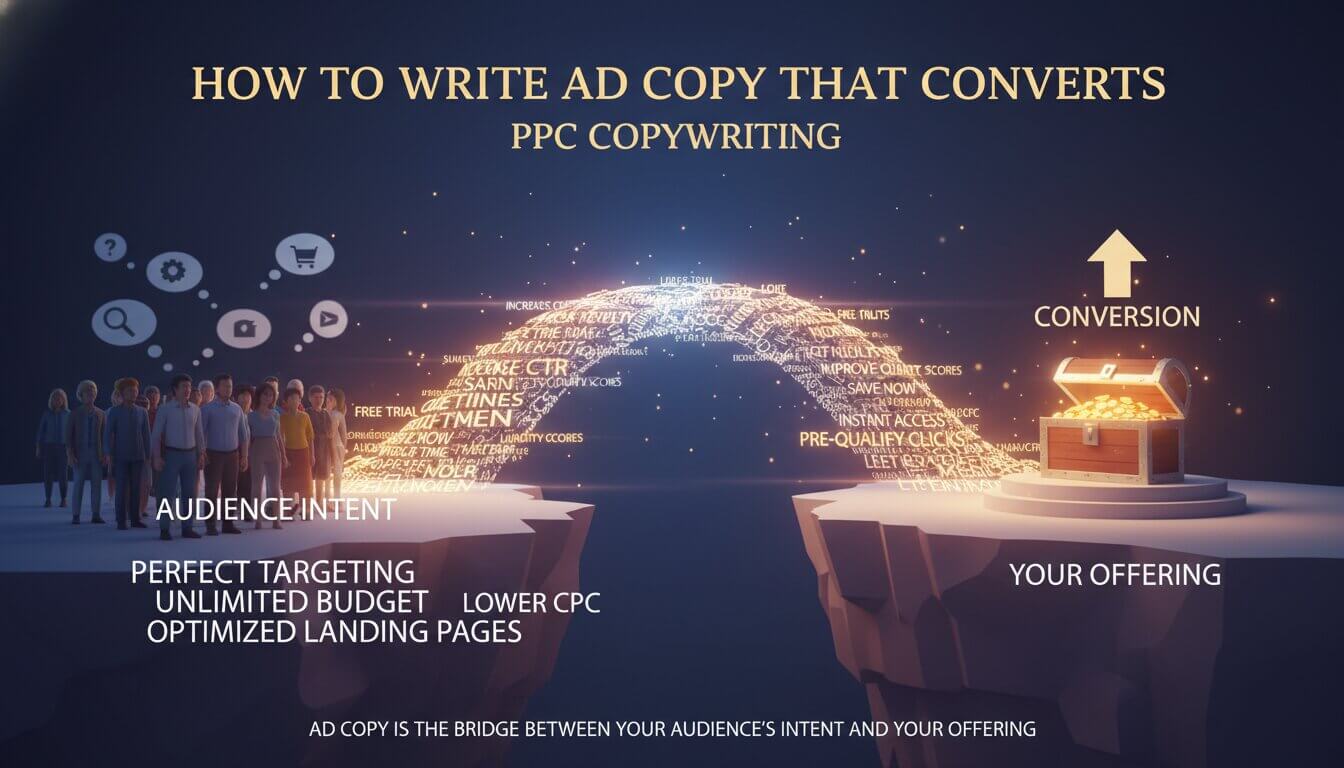
You can have perfect targeting, unlimited budget, and optimized landing pages — but if your ad copy fails to capture attention and persuade clicks, your campaigns will underperform. Ad copy is the bridge between your audience’s intent and your offering. Great ad copy increases click-through rates, improves Quality Scores (lowering costs), and pre-qualifies visitors so they are more likely to convert after clicking.
The Anatomy of High-Converting Ad Copy
Every effective ad follows a structure: hook the reader’s attention, connect with their pain point or desire, present your solution with proof, and drive action with a compelling CTA. In Google Ads, you have limited characters to accomplish this — 30 characters per headline and 90 per description. Facebook and Instagram give more creative space but compete with an endless content feed. Every word must earn its place.
Google Ads Copywriting Formulas
Formula 1: Keyword + Benefit + CTA
Headline 1: Include the search keyword to signal relevance. Headline 2: State the primary benefit or differentiator. Headline 3: Clear call-to-action. Example: ‘Digital Marketing Services | 3X Your Leads in 90 Days | Get a Free Strategy Call.’ This formula works because it mirrors the search query, promises a specific outcome, and tells the user exactly what to do.
Formula 2: Problem + Solution + Proof
Headline 1: Address the pain point. Headline 2: Present your solution. Description: Provide proof and CTA. Example: ‘Struggling With Low Website Traffic? | Expert SEO That Delivers Results | 500+ businesses trust Digigrowvity. Average 287% traffic increase. Free audit.’ This approach demonstrates empathy and backs claims with evidence.
Formula 3: Number + Specificity + Urgency
Headline 1: Lead with a specific number. Headline 2: Add specificity and uniqueness. Headline 3: Create urgency. Example: ’10X Your ROI With Google Ads | Certified Experts, 200+ Clients | Limited Slots — Book Today.’ Numbers build credibility and specificity, while urgency drives immediate action.
Facebook and Instagram Ad Copy Best Practices
Social media ad copy needs to stop the scroll in a noisy feed. Lead with a hook — a bold statement, surprising statistic, provocative question, or relatable pain point. Keep the first line under 125 characters (the truncation point before ‘See More’). Use short paragraphs and line breaks for readability. Include emojis strategically to draw the eye but do not overuse them. End with a clear CTA that matches the ad’s objective — ‘Shop Now,’ ‘Learn More,’ ‘Book a Call,’ or ‘Download Free Guide.’
The most effective Facebook ad structures include: testimonial-led ads that open with a customer quote, story-led ads that describe a transformation, listicle ads that promise specific tips or strategies, and direct-offer ads with clear value propositions. Test multiple copy angles for every campaign — the winning message is often not what you expect.
Power Words That Boost Clicks
Urgency Words
Now, today, limited, last chance, deadline, hurry, final, instant, immediately.
Free, bonus, exclusive, premium, guaranteed, proven, save, discount, complimentary.
Certified, trusted, award-winning, rated, verified, authentic, official, endorsed.
Curiosity Words
Secret, discover, reveal, unlock, hidden, surprising, little-known, breakthrough.
Exact numbers, percentages, timeframes, client counts, and measurable outcomes beat vague claims every time.
A/B Testing Your Ad Copy
Never assume you know which ad copy will perform best — test everything. Test one variable at a time for clear results: headline angles, benefit statements, CTAs, social proof elements, and emotional vs rational appeals. Run tests for at least 2 weeks or until you have statistical significance (typically 1,000+ impressions per variant). The winning ad becomes your new control, and you test a new challenger against it in a continuous improvement cycle.
Common Ad Copy Mistakes to Avoid
The biggest ad copy mistakes include being too generic (could apply to any business in your industry), focusing on features instead of benefits, using jargon your audience does not understand, making claims without proof, writing for search engines instead of people, and neglecting the landing page connection. Your ad copy makes a promise — your landing page must deliver on that promise, or visitors will bounce and your conversion rate will suffer.
Commonly asked questions
By offering concise and informative responses, this section helps users find solutions without the need to contact customer support, saving time
For Google Responsive Search Ads, provide the maximum 15 headlines and 4 descriptions per ad group. For Facebook Ads, test 3-5 ad copy variations per ad set. Always have at least 2 active variations to identify winners and continuously improve performance.
Include prices when they are competitive advantages or to pre-qualify clicks. 'Starting at ₹9,999/month' filters out budget-mismatched clicks, improving conversion rates. Omit prices when you want to drive inquiries and discuss value in person, or when pricing is complex.
Refresh ad copy every 4-8 weeks or when performance metrics decline. Ad fatigue occurs when the same audience sees the same ad repeatedly, causing declining CTR and increasing CPC. Introduce new angles, offers, and creative formats to maintain freshness.
Get Expert Ad Copywriting
Want ad copy that outperforms your competition? Our PPC copywriting specialists craft high-converting ads backed by data and continuous A/B testing.
Stay ahead with AI insights
Our team brings together deep expertise in AI, design, and technology to build tools that empower your creativity and productivity.