What is Quality Score and Why it Matters?
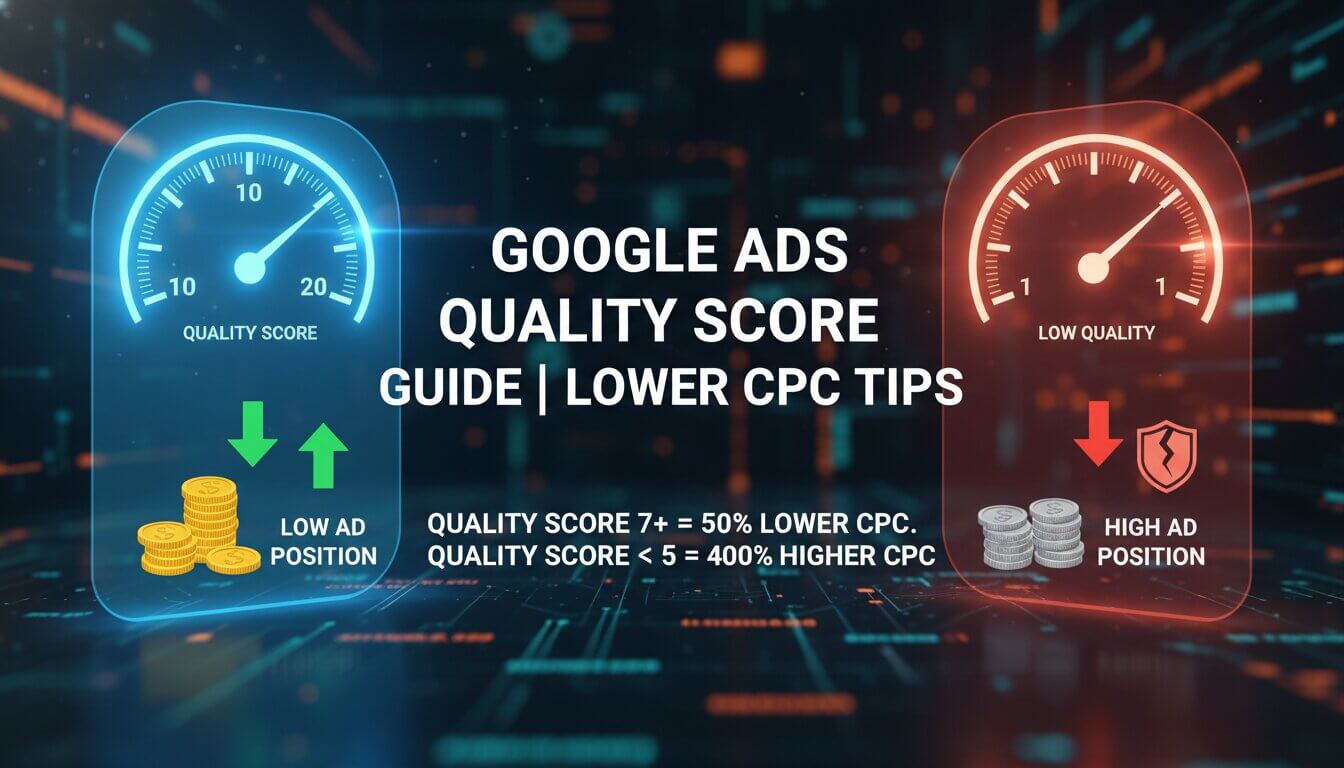
Quality Score is Google’s 1-10 rating of the quality and relevance of your keywords, ads, and landing pages. It directly impacts your cost per click (CPC) and ad position. A high Quality Score means you pay less per click and appear in higher positions than competitors bidding more. A Quality Score of 7+ can reduce your CPC by 50% compared to a score of 5, while a score below 5 can increase your CPC by 400% or more.
Google uses Quality Score because it wants to show users the most relevant ads. Advertisers with highly relevant ads and landing pages provide better user experiences, so Google rewards them with lower costs and better positions. Understanding and improving Quality Score is the single most impactful optimization for any Google Ads account.
The Three Components of Quality Score
Expected Click-Through Rate (CTR): : Google’s prediction of how likely your ad is to be clicked when shown for a keyword. Based on historical CTR data adjusted for ad position. Improve it by writing compelling ad copy with strong calls-to-action, using ad extensions, and ensuring keyword-ad relevance.
Ad Relevance: : How closely your ad copy matches the intent behind the search query. If someone searches ’emergency plumber Delhi’ and your ad says ‘General Home Services,’ ad relevance is low. Create tightly themed ad groups with keywords that closely match your ad headlines and descriptions.
Landing Page Experience: : How relevant, useful, and user-friendly your landing page is for people who click your ad. Google evaluates content relevance, page speed, mobile-friendliness, navigation ease, and transparency. The landing page should directly address the promise made in your ad.
Strategy 1: Restructure Your Ad Groups
The most impactful Quality Score improvement comes from tighter ad group structure. Each ad group should contain 5-15 closely related keywords that share a single intent. Create specific ad copy for each ad group that directly references those keywords. If an ad group contains keywords with different intents, split it into multiple ad groups. Single Keyword Ad Groups (SKAGs) or tightly themed ad groups consistently achieve the highest Quality Scores.
Strategy 2: Write Highly Relevant Ad Copy
Include the primary keyword in at least one headline — ideally Headline 1. Mirror the searcher’s language and intent in your descriptions. Use dynamic keyword insertion where appropriate but ensure ads still read naturally. Include specific benefits, numbers, and differentiators. Write at least 3 responsive search ad variations per ad group with 15 headlines and 4 descriptions that cover different angles and value propositions.
Strategy 3: Optimize Landing Pages
Create dedicated landing pages for each major ad group rather than sending all traffic to your homepage. Each landing page should match the ad’s promise with relevant content, include the target keyword in the headline and body, load in under 3 seconds, be fully mobile-responsive, have clear navigation and transparent contact information, and include a prominent call-to-action that matches the ad’s offer.
Strategy 4: Use Negative Keywords Aggressively
Negative keywords prevent your ads from showing for irrelevant searches, which improves CTR and ad relevance. Review your Search Terms Report weekly and add irrelevant queries as negative keywords. Common negative keyword categories include informational queries (how, what, why — if you only want transactional traffic), competitor names (unless intentional), job-related searches, and free/cheap modifiers for premium services.
Content marketing supports every other digital channel. SEO relies on content to rank for target keywords. Social media needs content to share. Email marketing needs content to deliver. PPC landing pages need persuasive content to convert. A strong content strategy acts as the connective tissue that ties your entire digital marketing ecosystem together.
Strategy 5: Leverage Ad Extensions
Ad extensions increase your ad’s visual footprint in search results and improve expected CTR. Use sitelink extensions to highlight key pages, callout extensions for unique selling points, structured snippet extensions for service categories, call extensions for phone-based businesses, and location extensions for local businesses. Ads with extensions have significantly higher CTR than those without.
Monitoring and Improving Over Time
Quality Score improvement is an ongoing process. Review Quality Scores weekly and prioritise improving keywords with scores below 6 that have high spend or volume. Track changes after implementing optimizations — improvements typically appear within 1-2 weeks as Google collects new performance data. Focus on the component rated 'Below Average' first, as that represents the biggest opportunity for improvement.
Commonly asked questions
By offering concise and informative responses, this section helps users find solutions without the need to contact customer support, saving time
A Quality Score of 7 or above is considered good and earns discounted CPCs. Scores of 8-10 are excellent. The average across most accounts is 5-6. Focus on getting your highest-spend keywords to 7+ for maximum cost savings.
Yes. Ad Rank = Bid × Quality Score. A higher Quality Score means you can achieve the same ad position with a lower bid. An advertiser with a Quality Score of 8 can outrank a competitor bidding twice as much with a Quality Score of 4.
Minor improvements (ad copy updates, adding extensions) can impact Quality Score within 1-2 weeks. Structural changes (ad group restructuring, new landing pages) may take 2-4 weeks to fully reflect in scores as Google needs sufficient data to re-evaluate.

Get a Google Ads Audit
Want expert help optimizing your Google Ads Quality Scores? Our certified PPC specialists audit and optimize accounts for maximum performance at minimum cost.
Stay ahead with AI insights
Our team brings together deep expertise in AI, design, and technology to build tools that empower your creativity and productivity.