

Complete AI Tools Framework for Automating a Digital Marketing Agency in 2026
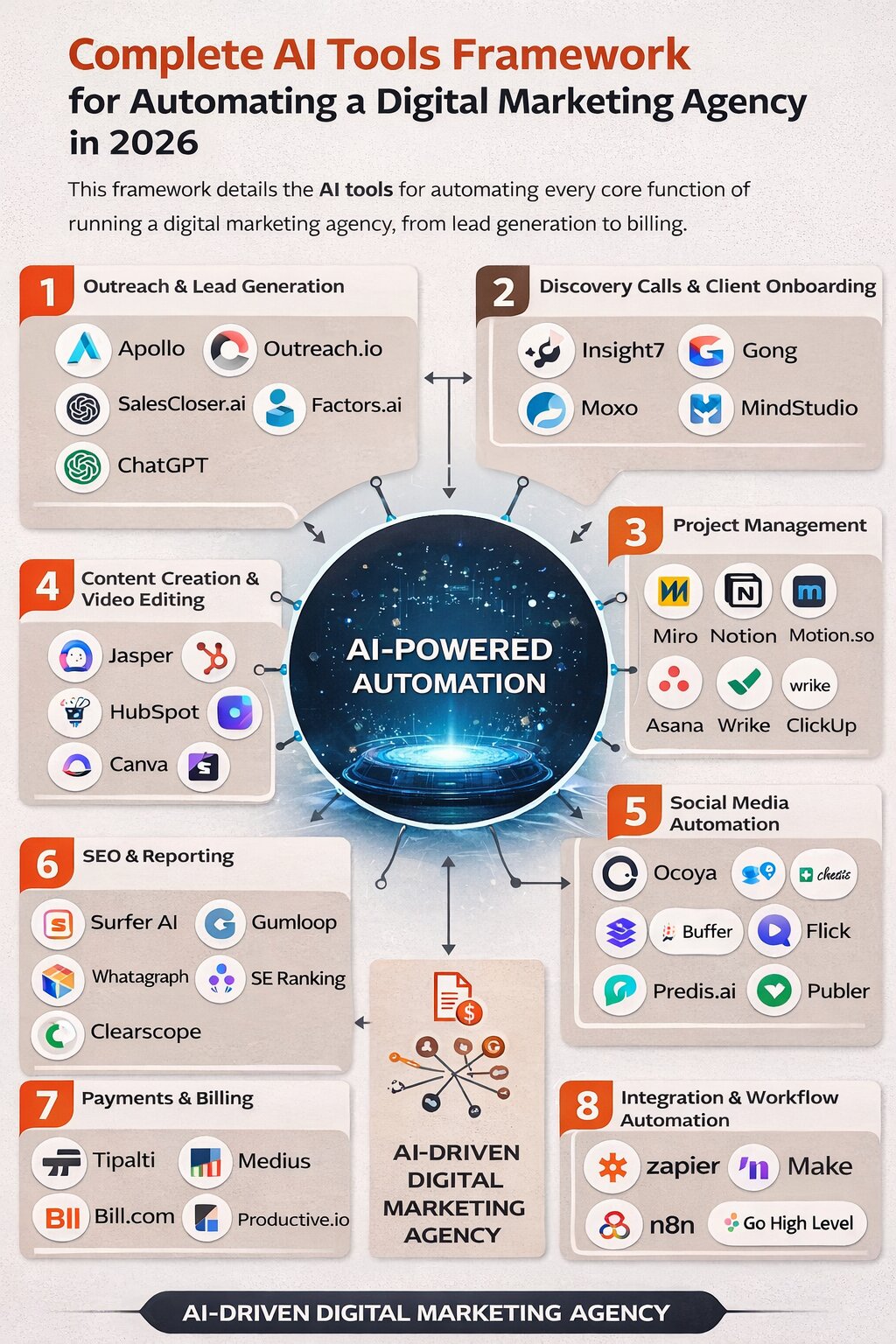
To run a digital marketing agency with minimal human intervention, you need a robust, end-to-end AI-powered framework that automates every core function—outreach, discovery calls, client onboarding, service delivery, payments, content creation, video editing, analytics, and workflow automation. This report details a comprehensive architecture and leading AI tools for each operational area, with integration best practices, to help you build and scale an agency that leverages AI as the operational backbone.
1. Overview: The Rise of AI-Driven Digital Marketing Agencies
By 2026, AI has moved from a competitive edge to a foundational requirement in digital marketing. Over 88% of marketers now use AI tools daily, with automation enabling agencies to move from concept to campaign execution in hours, personalize at scale, and operate with leaner teams—often running entire client accounts with minimal human oversight[1].
2. Core Pillars of the AI Automation Framework
2.1. Outreach and Lead Generation
AI-powered outreach tools automate prospect identification, lead qualification, and personalized engagement across multiple channels:
- Outreach.io: End-to-end sales engagement platform with AI agents for prospecting, deal management, and pipeline forecasting[2].
- Factors.ai: Tracks buyer intent across 20+ channels, prioritizes high-quality leads, and integrates with ad and website analytics[3].
- SalesCloser.ai: Automates discovery call scheduling, lead qualification, and appointment booking, acting as a virtual sales agent[4].
Free AI tools in 2026
For prospecting and outreach, Apollo offers a robust free tier for contact search, email automation, and campaign analytics, though advanced features may be limited after a trial period. You can use its AI email sequence builder to automate outreach, and integrate with Zapier for workflow connectivity. ChatGPT’s free version can help draft outreach copy and brainstorm campaign ideas.
2.2. Discovery Calls and Client Onboarding
AI agents now handle much of the discovery and onboarding process:
- Insight7 & Gong: AI conversation intelligence platforms that transcribe, analyze, and provide real-time suggestions during calls, enhancing lead qualification and onboarding[5].
- MindStudio & Moxo: Automate onboarding by extracting, validating, and routing client data, with AI handling document management, compliance checks, and workflow orchestration[6][7].
Free AI tools in 2026
For onboarding, Notion’s free plan can be used to create interactive client intake forms, knowledge bases, and automated onboarding checklists with AI writing assistance. For scheduling and basic call automation, tools like Google Calendar and Google Meet (both free) can be paired with ChatGPT to prepare call scripts and summarize meeting notes.
2.3. Project Management and Service Delivery
Modern project management platforms integrate AI for workload balancing, task automation, and client service:
- Motion, Asana, ClickUp, Notion: AI-driven project management tools for task scheduling, resource allocation, and workflow automation[8].
- Wrike: AI agents for risk monitoring, resource assignment, and workflow automation, with deep integration across marketing operations[9].
- Productive.io: End-to-end agency management platform combining resource planning, project management, CRM, reporting, and billing automation[10].
Free AI tools in 2026
Wrike, Zoho Projects, monday.com, Notion, and Miro all offer free plans with AI-powered features like task automation, scheduling, and collaboration, making them suitable for managing client projects and internal workflows without cost[1][2][3].
2.4. Content Creation and Video Editing
AI has revolutionized content production and creative workflows:
- Jasper: An AI agent workspace with 100+ specialized agents for content planning, creation, and publishing at scale[11].
- HubSpot AI: For automated marketing content, emails, and social copy[12].
- Runway: Advanced AI video/image creation and editing, with features like Gen-4 video, motion tracking, and green screen effects[13].
- Adobe Premiere Pro, Canva, CapCut: AI-powered video editing for professional and rapid social content production[14][15].
Free AI tools in 2026
ChatGPT and Canva AI are both free and widely used for content ideation, drafting, and graphic design. Canva’s AI social post generator can produce publish-ready content for multiple platforms, while ChatGPT can generate blog posts, captions, and outlines[1][2]. Eesel AI blog writer and AnswerThePublic offer limited free use for blog and SEO content[3].
CapCut is a popular free AI-powered video editor, especially for social content, and integrates directly with TikTok and other platforms. Other options with free tiers include Lumen5 (for turning text into video), and tools like Seedance and Krea, which offer basic AI video generation and editing features at no cost[1][2][3].
2.5. Social Media Management and Automation
AI tools now handle multi-channel publishing, content scheduling, and analytics:
2.6. SEO and Keyword Research Automation
2.7. Analytics and Reporting
AI analytics platforms unify data and automate insights:
Free AI tools in 2026
Google Analytics remains free for web and campaign analytics. For reporting automation, Notion and Google Sheets (with AI add-ons) can be used to automate report creation and visualization[1]. Some workflow automation tools (like n8n and Gumloop) also provide free plans for connecting analytics data across tools[2][3].
2.8. Payments, Billing, and Financial Automation
Automate invoicing, payments, and financial workflows:
Free AI tools in 2026
n8n and Gumloop both offer free plans for building AI-powered workflows that connect your marketing stack (email, CRM, content, analytics, etc.) and automate repetitive tasks[1][2]. Zapier and Make also have free tiers for basic workflow automation.
For invoicing and payment automation, Square, Wave, and Zoho Invoice all offer free plans with unlimited invoicing, payment reminders, and integration with payment processors. These tools are well-suited for small agencies and integrate with other free software via Zapier or native APIs[1][2][3].
3. All-in-One and Integration Platforms
While no single platform covers every function perfectly, some solutions are designed as agency operating systems:
- Go High Level: Combines CRM, automation, SMS/email, campaign management, and reporting in a single dashboard—ideal for agencies managing multiple clients[25].
- Make (formerly Integromat), Zapier: Visual workflow builders to orchestrate multi-app automation, connecting outreach, CRM, project management, and billing tools[26][27].
- Productive.io: Agency management platform with integrated project, resource, and financial management[10].
4. Framework Implementation: Best Practices and Tech Stack
4.1. Implementation Phases
- Audit and Planning: Map current workflows, tools, and bottlenecks. Identify integration points and prioritize automation areas for maximum ROI[27][28].
- Tech Stack Selection: Choose best-in-class AI tools for each function, prioritizing platforms with robust APIs and native integrations[27][29].
- Integration and Orchestration: Use workflow automation engines (Make, Zapier) to connect tools, synchronize data, and automate handoffs between outreach, CRM, project management, and billing[27][29].
- Workflow Design: Structure processes with clear inputs, rules, and quality gates—enabling AI agents to run workflows end-to-end with human oversight only for exceptions or strategic decisions[30][31].
- Testing and Optimization: Pilot with a few clients, measure outcomes, and iterate. Use analytics to refine automations and address gaps[29][32].
4.2. Integration Considerations
- APIs and Data Sync: Choose tools with open APIs and real-time data sync.
- Unified Reporting: Ensure analytics and reporting tools aggregate data from all systems.
- Security and Compliance: Prioritize platforms with strong security, compliance, and audit capabilities[29].
- Scalability: Select tools and frameworks that grow with your agency and support multi-client management.
5. Example: End-to-End AI Workflow (Outreach to Billing)
- Lead Generation: Outreach.io or Factors.ai identifies and qualifies leads, books discovery calls via SalesCloser.ai.
- Discovery & Onboarding: AI agents (Insight7, MindStudio, Moxo) conduct calls, extract requirements, and automate onboarding documentation.
- Project Kickoff: Tasks and timelines are auto-generated in Motion, ClickUp, or Productive.io, with client portals for collaboration.
- Content & Campaigns: Jasper and Runway drive content and video creation, scheduled and distributed via Ocoya or FeedHive.
- SEO & Analytics: Surfer AI and Gumloop optimize content; Whatagraph aggregates performance data for client dashboards.
- Payments & Billing: Tipalti or Medius automates invoicing, payment tracking, and financial reporting.
- Continuous Optimization: AI analytics tools surface insights for campaign improvement and workflow refinement[30][31].
6. ROI and Efficiency Gains
7. Conclusion
Running a digital marketing agency in 2026 without heavy human dependence is now possible by systematically deploying AI tools across every workflow. The ideal stack leverages specialized AI agents for outreach, onboarding, content, analytics, and billing, orchestrated through integration platforms for seamless automation. With careful planning, tool selection, and phased implementation, agencies can achieve high efficiency, scalability, and profitability—transforming the traditional agency model for the AI era.
Kevindaymn
Stackshine Get Started simplifies SaaS spend management with full software visibility, renewal tracking, and employee offboarding automation. Reduce costs, eliminate unused tools, and gain control over subscriptions with a smarter, centralized platform.