Amazon vs Flipkart Sellers | Where to Focus

Leo Daniel Raja

Amazon vs Flipkart sellers

The Indian E-Commerce Landscape

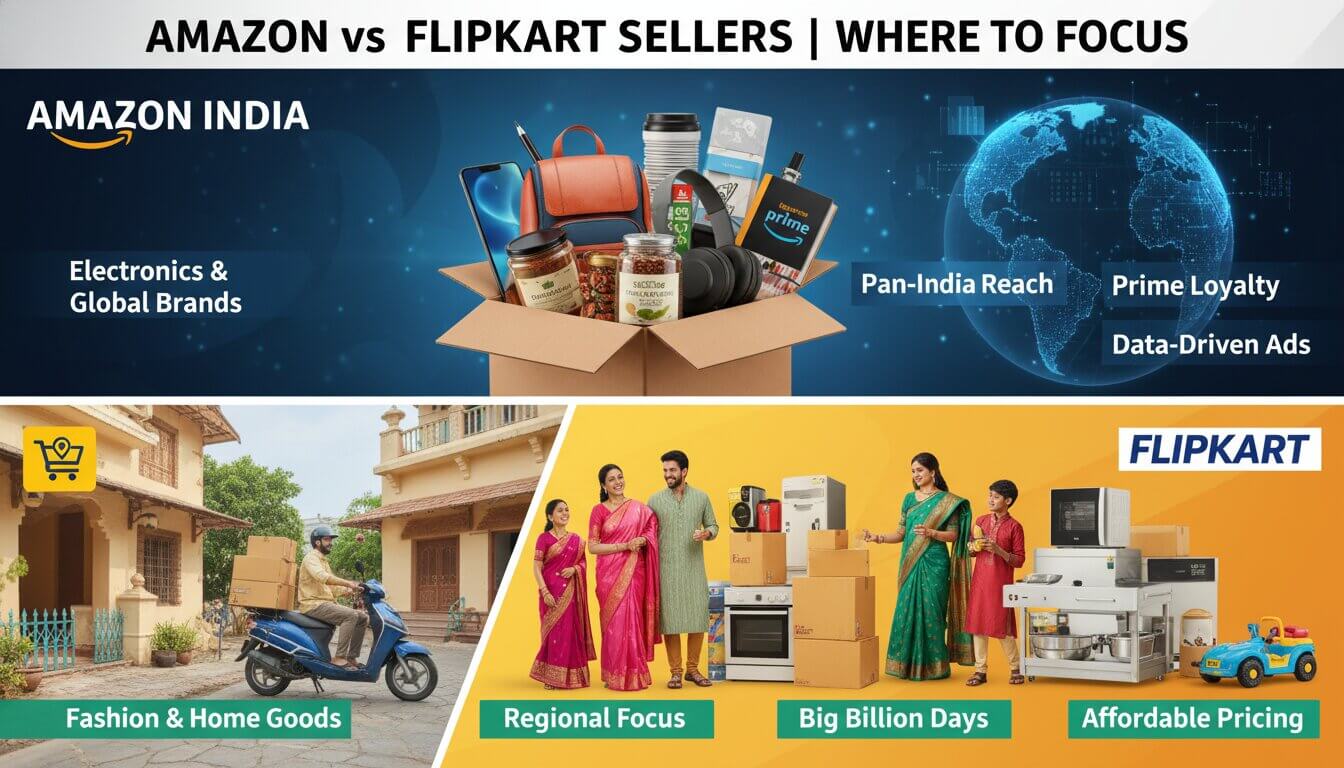
India’s e-commerce market is dominated by two platforms: Amazon India and Flipkart (owned by Walmart). Together, they account for over 60% of India’s online retail market. For sellers, the question is not whether to sell online but where to focus limited marketing resources and inventory. The right answer depends on your product category, target audience, pricing strategy, and growth objectives.

Market Share and Audience Demographics

Amazon India and Flipkart each command roughly 30% of India’s e-commerce market, with the remainder split among Meesho, JioMart, and niche platforms. However, their audiences differ significantly. Amazon India attracts a slightly higher-income, metro-focused demographic with strong preference for electronics, international brands, and premium products. Flipkart has deeper penetration in Tier 2 and Tier 3 cities, a younger demographic, and dominates fashion, mobile phones, and value-oriented categories.

Fee Structure Comparison

Both platforms charge commission fees (referral fees) that vary by category, typically ranging from 5-25%. Flipkart’s commission rates are generally comparable to Amazon’s, though they differ by category. Fulfilment fees, shipping charges, and payment processing costs add to the total. Calculate your net margin on each platform before committing inventory — the same product may be more profitable on one platform due to category-specific fee differences.

Advertising and Marketing Tools

Amazon Advertising

Amazon offers the most mature advertising platform with Sponsored Products, Sponsored Brands, Sponsored Display, Amazon DSP, and Brand Analytics. The advertising tools are sophisticated with detailed targeting options, bid optimization, and comprehensive reporting. Amazon’s advertising ecosystem is the most advanced among Indian marketplaces.

1 12 DIGIGROWVITY Digital Growth without Limits Amazon vs Flipkart Sellers | Where to Focus Analytics & Reporting Amazon vs Flipkart sellers

Flipkart Advertising

Flipkart Ads offers Product Listing Ads (PLA), Brand Ads, and Display Ads. While less mature than Amazon’s platform, Flipkart’s advertising has improved significantly and offers competitive CPCs, especially during sale events. Flipkart’s Big Billion Days and other sale events generate massive traffic that sellers can leverage through increased ad spend.

pay per click advertising ppc vibrant colors highly detailed professional photography 1776621890016 DIGIGROWVITY Digital Growth without Limits Amazon vs Flipkart Sellers | Where to Focus Analytics & Reporting Amazon vs Flipkart sellers

Fulfilment Options

01

Amazon FBA (Fulfilment by Amazon)

Store inventory in Amazon warehouses. Amazon handles picking, packing, shipping, and customer service. FBA products get Prime eligibility and faster delivery, significantly boosting conversion rates.

02

Flipkart Fulfilment (Flipkart Assured)

Similar to FBA — store inventory in Flipkart warehouses for faster delivery and the Flipkart Assured badge. Products with this badge see 2-3x higher conversion rates.

03

Self-Fulfilment

Both platforms allow sellers to handle their own fulfilment, offering more control but requiring logistics infrastructure and potentially lower conversion rates due to longer delivery times.

Category-Based Recommendations

01

Focus on Amazon For

Electronics and gadgets (strong buyer trust for high-value items), books and media, international brand products, home and kitchen premium segments, health and personal care products, and products targeting metro audiences willing to pay premium prices.

02

Focus on Flipkart For

Fashion and apparel (Flipkart's largest category), mobile phones and accessories, budget and mid-range products, products targeting Tier 2 and Tier 3 cities, grocery and essentials, and categories where price sensitivity is the primary buying factor.

03

Sell on Both When

You have sufficient inventory and operational capacity, your product category performs well on both platforms, you want maximum market coverage, and you have the marketing budget to advertise on both platforms simultaneously.

The Multi-Platform Strategy

Most successful Indian sellers eventually sell on both platforms. Start with the platform that best matches your product category and audience, establish strong sales and reviews, then expand to the second platform. The key is not splitting focus too early — it is better to dominate one platform before spreading resources across two.

Faq

Commonly asked questions

By offering concise and informative responses, this section helps users find solutions without the need to contact customer support, saving time

Amazon is often easier for new sellers due to its comprehensive seller education resources, Brand Registry program, and FBA infrastructure. However, if your products are in fashion or budget categories, Flipkart may offer faster initial traction with less competition.

Yes, maintain consistent pricing across platforms. Both Amazon and Flipkart monitor cross-platform pricing, and significant price differences can affect your Buy Box eligibility and listing visibility. Account for different fee structures in your margin calculations.

Amazon and Flipkart often run competing sale events (Great Indian Festival vs Big Billion Days). Participate in both if possible, but allocate more inventory and ad budget to the platform where your category performs best during sales.

Get a Marketplace Strategy

Need a marketplace strategy that maximizes your presence on Amazon and Flipkart? Our e-commerce specialists manage and optimize your listings across both platforms.

Share this post

Leave a Reply