The Modern Patient Journey Starts Online
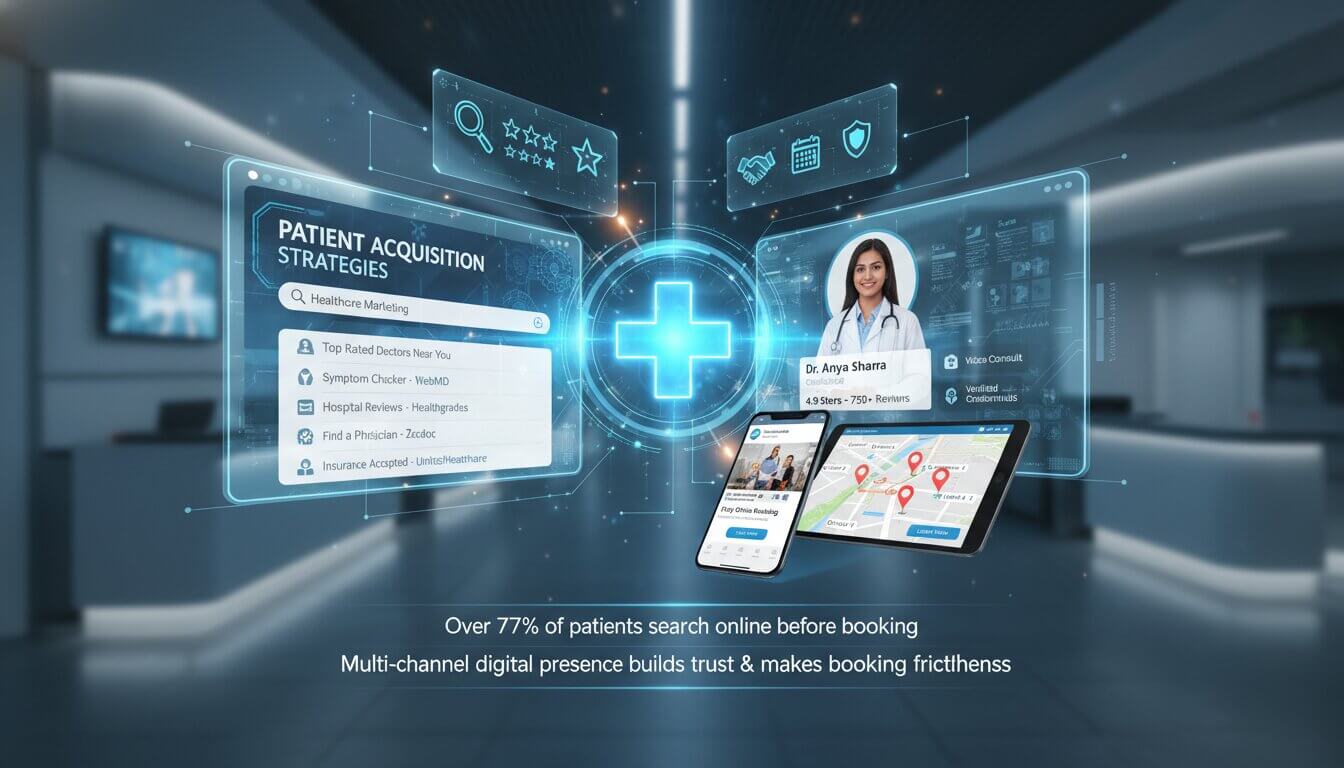
Over 77% of patients search online before booking a healthcare appointment. They research symptoms, compare providers, read reviews, verify credentials, and check locations and insurance acceptance — all before picking up the phone. Healthcare providers who are not visible in these online research moments lose patients to competitors who are. Patient acquisition in 2025 requires a multi-channel digital presence that builds trust and makes booking frictionless.
Strategy 1: Dominate Local Search
Local SEO is the highest-priority digital strategy for healthcare providers because nearly all patient searches have local intent (‘cardiologist near me,’ ‘best hospital in Hyderabad’). Fully optimize your Google Business Profile with accurate information, photos, and regular posts. Build local citations across healthcare directories (Practo, Lybrate, Justdial). Create location-specific landing pages for each clinic or hospital branch. Ensure your website’s NAP (Name, Address, Phone) matches your GBP listing exactly.
Strategy 2: Build a Patient-Focused Website
Your website is your digital front door. It must immediately communicate trust, expertise, and accessibility. Essential elements include: doctor profiles with credentials, experience, and specialisations prominently displayed; service pages for every department and treatment offered; online appointment booking that works seamlessly on mobile; patient testimonials and success metrics; insurance and payment information; clear contact information with click-to-call on mobile; and fast loading speed (under 3 seconds).
Strategy 3: Google Ads for Immediate Patient Acquisition
Google Ads puts your practice at the top of search results for high-intent healthcare queries. Target service-specific keywords (‘knee replacement surgeon Delhi’), condition-specific keywords (‘treatment for diabetes’), and location-based keywords (‘best ENT specialist near me’). Healthcare Google Ads campaigns typically achieve strong ROI because the patient lifetime value is high — a single new patient may generate ₹50,000-₹5,00,000+ in lifetime revenue.
Create dedicated landing pages for each ad group that match the search intent exactly. A patient searching for ‘knee replacement’ should land on a page specifically about your knee replacement services, not your general orthopaedics page. Include clear calls-to-action, doctor credentials, patient outcomes, and a simple appointment booking form.
Strategy 4: Content Marketing for Health Education
Educational health content serves two purposes: it ranks in organic search for condition and treatment queries, and it establishes your doctors as trusted authorities. Create blog articles answering common patient questions about conditions, treatments, and prevention. Produce video content with doctors explaining procedures, recovery expectations, and health tips. Health content written by or reviewed by qualified doctors (E-E-A-T signals) ranks significantly better in Google’s health-related search results.
Strategy 5: Online Reputation Management
Healthcare reputation directly impacts patient acquisition — 84% of patients trust online reviews as much as personal recommendations. Implement a systematic review generation process: request reviews from satisfied patients via SMS or email within 24 hours of their visit. Respond to every review professionally. Monitor review sites including Google, Practo, Justdial, and Facebook. Address negative reviews promptly with empathy and offline resolution.
Strategy 6: Patient Referral Programmes
Referrals remain the most trusted source of new patients. Formalise your referral programme: create referral cards patients can give to friends and family, develop a physician referral network with regular communication and case feedback, implement a thank-you system for referring patients (compliant with healthcare regulations — no financial incentives for patient referrals). Track referral sources to understand which channels generate the highest-value patients.
Strategy 7: Social Media for Community Building
Healthcare social media should educate and build trust, not hard-sell. Share health awareness content, doctor introductions, behind-the-scenes facility content, community event participation, and health observance day content. Facebook and Instagram work well for patient education and community engagement. LinkedIn is effective for physician recruitment and B2B partnerships. YouTube is ideal for procedure explanations and doctor interviews.
Commonly asked questions
By offering concise and informative responses, this section helps users find solutions without the need to contact customer support, saving time
Healthcare patient acquisition costs vary significantly by specialty: ₹500-₹2,000 for general practice, ₹2,000-₹8,000 for specialties, and ₹5,000-₹20,000 for surgical procedures. These costs decrease as organic channels (SEO, content, reviews) mature and reduce dependency on paid advertising.

Google Ads generates new patient enquiries within days. Local SEO improvements show within 2-4 months. Content marketing and organic SEO take 4-8 months for meaningful results. A comprehensive strategy combining all channels typically shows significant patient growth within 6 months.
Extremely effective. Small clinics often see the highest ROI from digital marketing because they compete locally where patient trust and proximity drive decisions. Local SEO, Google Business Profile, and targeted Google Ads can fill appointment schedules at a fraction of traditional advertising costs.
Grow Your Patient Base
Ready to grow your hospital or clinic's patient base? Our healthcare marketing specialists build compliant, results-driven digital strategies for medical practices.
Stay ahead with AI insights
Our team brings together deep expertise in AI, design, and technology to build tools that empower your creativity and productivity.