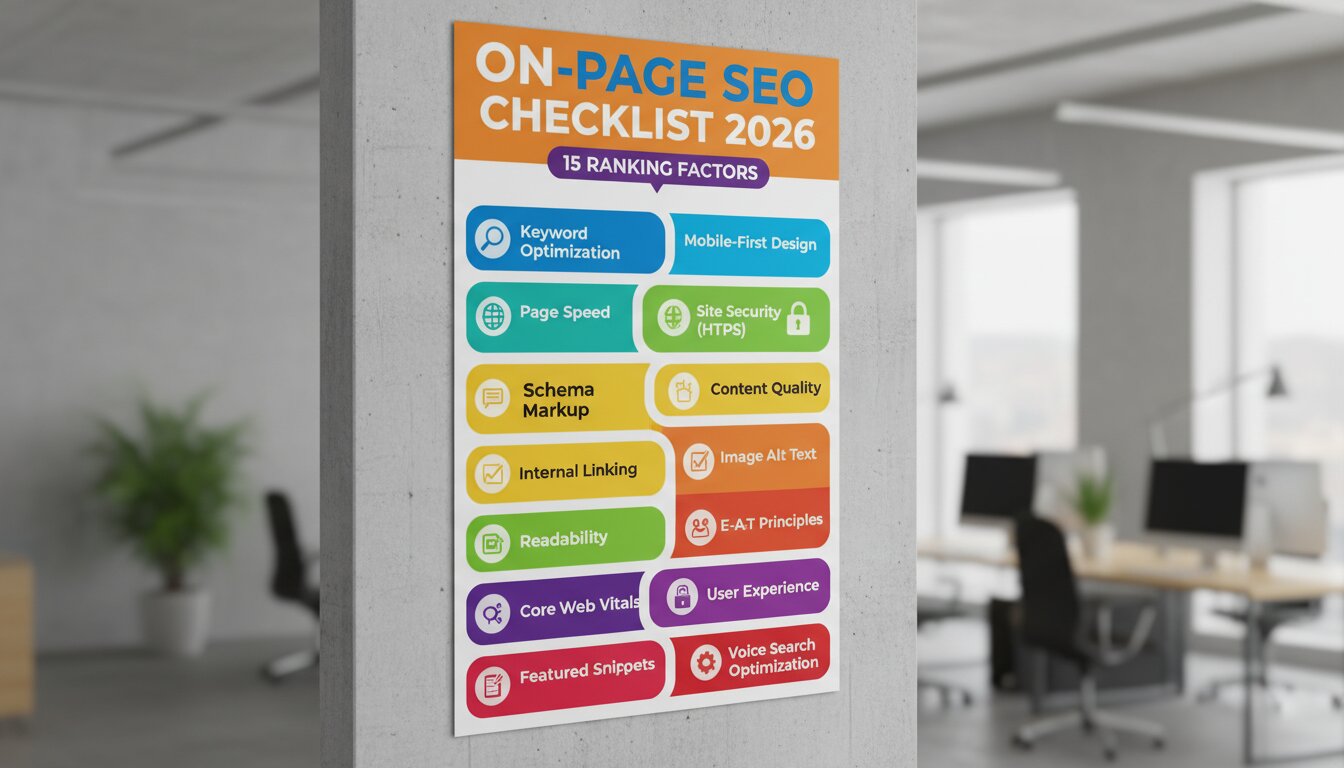
On page SEO Checklist refers to the optimizations you make directly on your website pages to improve search engine rankings and user experience. Unlike off-page SEO (backlinks) or technical SEO (site architecture), on-page SEO is entirely within your control. Properly optimized pages tell search engines exactly what your content is about, who it serves, and why it deserves to rank. Here are 15 critical factors every page on your website should address.
Title Tag Optimization
The title tag is the single most important on-page SEO element. It appears in search results, browser tabs, and social shares. Include your primary keyword near the beginning, keep it under 60 characters, and make it compelling enough to earn clicks. Use power words, numbers, and the current year when relevant. Every page should have a unique title tag — duplicate titles confuse search engines and dilute ranking signals.
Meta Description Optimization
While not a direct ranking factor, meta descriptions significantly impact click-through rates. Write 150-160 character descriptions that include your primary keyword, convey the page’s value proposition, and include a call-to-action. Think of meta descriptions as ad copy for your organic search listings — they must persuade searchers to click your result over competitors.
Heading Structure (H1-H6 Tags)
Use a single H1 tag per page containing your primary keyword. Organize content with H2 subheadings for main sections and H3-H4 for subsections. This hierarchical structure helps search engines understand content organization and enables featured snippet selection. Include secondary keywords and question-based headings naturally throughout your heading structure.
The Complete 15-Factor Checklist
Title Tag
Primary keyword near start, under 60 characters, unique per page, compelling for clicks.
Meta Description
150-160 characters, includes keyword, clear value proposition, call-to-action.
URL Structure
Short, descriptive, includes keyword, uses hyphens, no unnecessary parameters.
H1 Tag
One per page, contains primary keyword, matches search intent.
H2-H3 Tags
Logical hierarchy, includes secondary keywords, question-based where appropriate
Content Quality
Comprehensive, original, E-E-A-T signals, answers user intent completely.
Keyword Placement
Primary keyword in first 100 words, naturally throughout content, no keyword stuffing.
Internal Links
3-5 contextual internal links per page, descriptive anchor text, link to related content.
External Links
2-3 links to authoritative sources, opens in new tab, adds credibility.
Image Optimization
Descriptive alt text with keywords, compressed file sizes, descriptive filenames.
Page Speed
Under 3 seconds load time, optimized images, minified CSS/JS, lazy loading.
Mobile Responsiveness
Fully responsive design, readable without zooming, touch-friendly elements.
Schema Markup
Relevant structured data (Article, FAQ, HowTo, Product), validates in testing tool.
Content Length
Sufficient to cover topic comprehensively — typically 1,500-3,000+ words for competitive terms.
The most damaging on-page SEO mistakes include keyword stuffing (using your keyword unnaturally), duplicate content across multiple pages, missing or duplicate title tags, ignoring image alt text, thin content that does not fully address the topic, and neglecting internal linking. Each of these errors sends negative signals to search engines and can suppress your rankings.
Another critical mistake is optimizing for search engines rather than users. Google’s algorithms increasingly reward content that genuinely serves user intent. If your content reads like it was written for a bot rather than a human, rankings will suffer regardless of technical optimisation quality.
Faq’s
Commonly asked questions
By offering concise and informative responses, this section helps users find solutions without the need to contact customer support, saving time
On-page SEO improvements typically show results within 2-8 weeks. Google recrawls and reindexes pages regularly, and well-optimized pages often see ranking improvements within the first month. Competitive keywords may take 3-6 months to show significant movement.
Content quality and relevance are the most important on-page factors. Google prioritizes content that comprehensively satisfies search intent. Title tags and heading structure are the most important technical on-page elements.
Use your primary keyword naturally in the H1 and at least one H2. For other headings, use variations, synonyms, and related terms rather than forcing exact-match keywords. Google understands semantic relationships and rewards natural language.
Request an SEO Audit
Want a professional audit of your website's on-page SEO? Our experts will analyze every page and provide a prioritized optimization roadmap.